
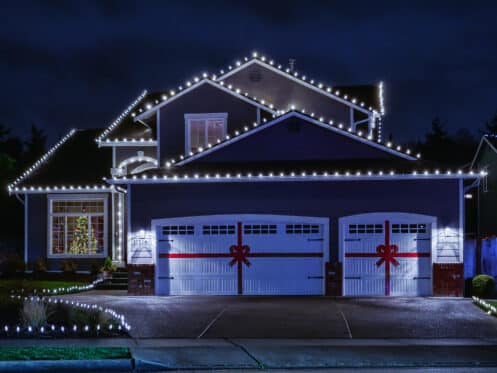
Adorning your home with lights and decorations is a great way to get into the holiday spirit, but all of those lights can also be a major safety hazard. Statistics show that the incidence of house fires greatly increases over the winter holiday season. While cooking and heating systems are still the biggest sources of residential structural fires, about 25% of all holiday fires are started by lights and other electrical decorations. The number of people who suffer electrical shock or electrocution also increases over the holiday season. The good news is that preventing electrical fires and other hazards during the holidays is easy as long as you follow a few safety tips.
1. Inspect All Holiday Lights, Power Strips, and Cords
When it comes time to hang all your lights and put out your lighted decorations, you should carefully inspect everything. Check all of your strings of lights and cords for any signs of damage. If you see any frayed or exposed wires, throw the lights or decorations away and replace them. Damaged wires can easily result in an electrical shock or cause a short circuit that can easily start a fire. Broken bulbs in a string of lights can also lead to a short circuit, so replace any broken bulbs before plugging the lights in.
If you’re using power strips and extension cords to plug in your lights and decorations, inspect them for any signs of damage. Check that the outlets on a power strip show no signs of melting or smoke. If one of the outlets is black or yellow or the holes look like they’ve melted, you need to toss the strip in the trash and use a different one. These issues indicate that there is either a damaged wire or a loose connection in the outlet, which can cause the current to arc and the strip to catch fire.
2. Don’t Overload Outlets and Electrical Circuits
While damaged lights, decorations, and cords are common causes of fires and electrocutions, most holiday electrical fires result from people plugging too many things into one outlet or one circuit. If you try to run too many lights and decorations off of one circuit, you can also easily overload the circuit, causing the breaker to frequently trip. Overloading a circuit can also cause the wires to overheat and potentially catch fire.
To determine how many lights and decorations you can run on a single circuit, you’ll first need to open your electrical panel and find out whether a specific circuit is 15 or 20 amps. Each circuit in the panel will typically be clearly labeled so that you can easily find the right one. If the circuits aren’t labeled, you’ll need to turn off the circuit breakers one by one until you see the lights in a particular area switch off.
No matter whether it is a 15- or 20-amp circuit, you should never exceed 80% of its total capacity. This will help to ensure that the breaker doesn’t trip and also avoid issues with overheating wires and fire hazards. If it’s a 15-amp circuit, you don’t want to exceed 1,440 watts. For a 20-amp circuit, you don’t want to go above 1,920 watts.
Once you know the amperage of the circuit and how many watts it can handle, you can then easily calculate how many strings of lights you can safely plug into that circuit. All light strings and electrical decorations should have a tag that shows their wattage, and the wattage will also be listed on the box they came in. You can then add up the wattage of all of the different strings and decorations to calculate how many you can connect to the circuit. However, you also need to factor in the wattage of anything else that is on that same circuit, such as ceiling lights or appliances.
You also don’t want to daisy-chain too many strings of lights together. The maximum for a daisy-chained string is 210 watts. A string of 100 incandescent mini-lights is usually around 40 watts, which means you never want to connect more than five strings. Most strings of mini-LED lights are only around 12 watts, meaning you could potentially connect up to 17 LED strings.
3. Use the Correct Type of Lights and Cords for Each Situation
All lights and cords you use outside must be rated for outdoor use. Indoor lights and extension cords aren’t waterproof and can short-circuit if exposed to water. If you touch a cord or light string that has gotten wet, you could get a nasty shock.
Christmas tree fires are also a common holiday occurrence, and most of them are caused by lights and electrical decorations. If you’re using a real tree, you need to keep it well-watered to prevent the needles from drying out. Another easy way to lessen the risk of your tree catching fire is to decorate it with LED light strings. Incandescent bulbs can get fairly hot and potentially cause dry needles to catch fire whereas LED bulbs produce almost no heat.
4. Turn Off All Lights Before Leaving Home or Going to Bed
Another way to lessen the risk of an electrical fire is to never leave your lights and electrical decorations unattended. This means making sure you turn all of them off any time you’re leaving home and also at night when you’re going to bed. While a fire could occur when you’re at home and awake, you’ll at least have time to act in this situation unlike if a fire starts when you’re away or sleeping.
5. Schedule an Electrical Safety Inspection Before Putting Up Your Lights
You should always have your electrical system fully inspected and maintained by a licensed electrician at least once a year. The fact that more electrical fires occur during the holiday months than at any other time of the year means that it’s a good idea to schedule this inspection and maintenance call before the holidays come. This way, you can ensure that your electrical system has no issues and that it is safe to put up your lights and decorations. When inspecting and maintaining your electrical system, the electrician will check and test all of your outlets and circuit breakers. If the inspection reveals any issues, you will then have plenty of time to have them repaired before the holiday season arrives.
If you love going all out with lighting the outside of your home, you may also want to consider having an electrician install one or more dedicated holiday light circuits. This will help to prevent issues with overloaded circuits and also make it so that you don’t have to use as many extension cords.
At AJ Danboise Plumbing, Heating, Cooling & Electrical, we’ve been providing expert electrical, HVAC, and plumbing services to customers in the Farmington Hills and the Detroit Metro area since 1925. If you need to have your electrical system inspected and maintained or need any other electrical services this holiday season, give us a call.